Reuse over replace1 reused tote = ~60 kg CO₂e avoidedTriple-rinsed & inspectedDiverting plastic from landfill since day oneSteel cages built to outlast many fill cyclesLocally reconditioned in Somerville, MAReuse over replace1 reused tote = ~60 kg CO₂e avoidedTriple-rinsed & inspectedDiverting plastic from landfill since day oneSteel cages built to outlast many fill cyclesLocally reconditioned in Somerville, MA
Why we existWe saw waste that didn't have to happen — so we built the loop to close it.
Intermediate bulk containers are engineered to last for many fill cycles. Yet thousands are scrapped every year while they still have years of service left. That gap — between how long a tote can last and how long it actually gets used — is the entire reason this company exists.
Our job is to make reuse the easiest, cheapest, most obvious choice for every business in New England that touches bulk liquid. When reuse is the default, the landfill loses.
The road here
From one washer to a regional loop.
2014
A dock full of perfectly good totes
Our founders spent years in food-and-beverage logistics, watching pallet after pallet of sound IBC totes get crushed and landfilled simply because reusing them was inconvenient. IBC Boston started in a rented Somerville bay with one washer, a pressure tester, and a stubborn belief that a clean tote is an asset, not trash.
2017
Our first real reconditioning line
Demand outgrew the garage. We built a structured intake-to-certify line: sort by prior contents, triple-rinse, pressure-test, re-gasket, re-valve, grade and label. For the first time we could guarantee — in writing — what every tote had held and how it had been cleaned.
2020
We put our own trucks on the road
Freight was the bottleneck between us and a truly circular tote economy. We added transport so we could pick up empties and deliver reconditioned totes across New England on our own schedule, cutting wasted miles and middlemen.
2023
Upcycled goods line opens
Totes that failed inspection used to mean regrind. We launched an upcycling workshop turning sound-but-retired bottles and cages into rain barrels, planters, and storage — keeping material in its highest-value use for as long as physically possible.
2026
Where we are today
A reuse-first specialist serving farms, breweries, manufacturers, municipalities and makers across the region — still in Somerville, still email-only, still measuring success in totes kept out of the ground.
What we stand for
Four values that decide everything we do.
Reuse before recycle, recycle before waste
Our hierarchy is strict: keep a tote in service, then rebottle, then upcycle, then regrind. Landfill is the last resort, not the default.
Radical transparency on history
Every tote is labeled with documented prior contents and a clear grade. You should never have to guess what a container held.
Email-only, no pressure
We don't run a phone room or chase you with calls. Send a form, get a straight answer by email. The work speaks louder than a sales pitch.
Local loops beat long hauls
Reconditioning regionally means short transport legs and a tighter circular economy — good for cost, better for carbon.
Our reconditioning standardThe line every tote walks before it carries your name.
Reconditioning is where reuse becomes safe. It is a structured, repeatable process — not a hose and a guess — and the same six stages apply to a single tote or a full truckload.
Intake & sort
We log prior contents, separate food-history from industrial units, and reject anything that held a hazardous residue we won't process.
Empty, drain & wash
Residual liquids are captured for licensed disposal — never the ground. Then hot water, food-safe detergent and a triple-rinse cycle scrub the interior via a rotating spray ball.
Pressure & leak test
Each bottle is checked for cracks, stress-whitening and valve-seal integrity. Food-grade units get an added sanitizing pass.
Re-gasket & re-valve
Worn 2-inch valves, gaskets and 6-inch caps are swapped for new so the tote seals like the day it left the plant.
Cage & pallet repair
Bent tubes are straightened, broken welds repaired, and pallets reinforced so the galvanized steel keeps carrying load safely.
Certify, grade & label
The unit is graded A or B, tagged with its documented history, and added to inventory — or, if it fails, routed to regrind. Nothing usable is crushed.
6 stages
Intake to certify — every tote, every time.
3×
Rinse passes minimum, plus a sanitizing pass on food-grade.
100%
Pressure & leak tested before it earns a grade.
A/B
Clear grade and documented history on every label.
Inside the yardWhere empties become assets again.
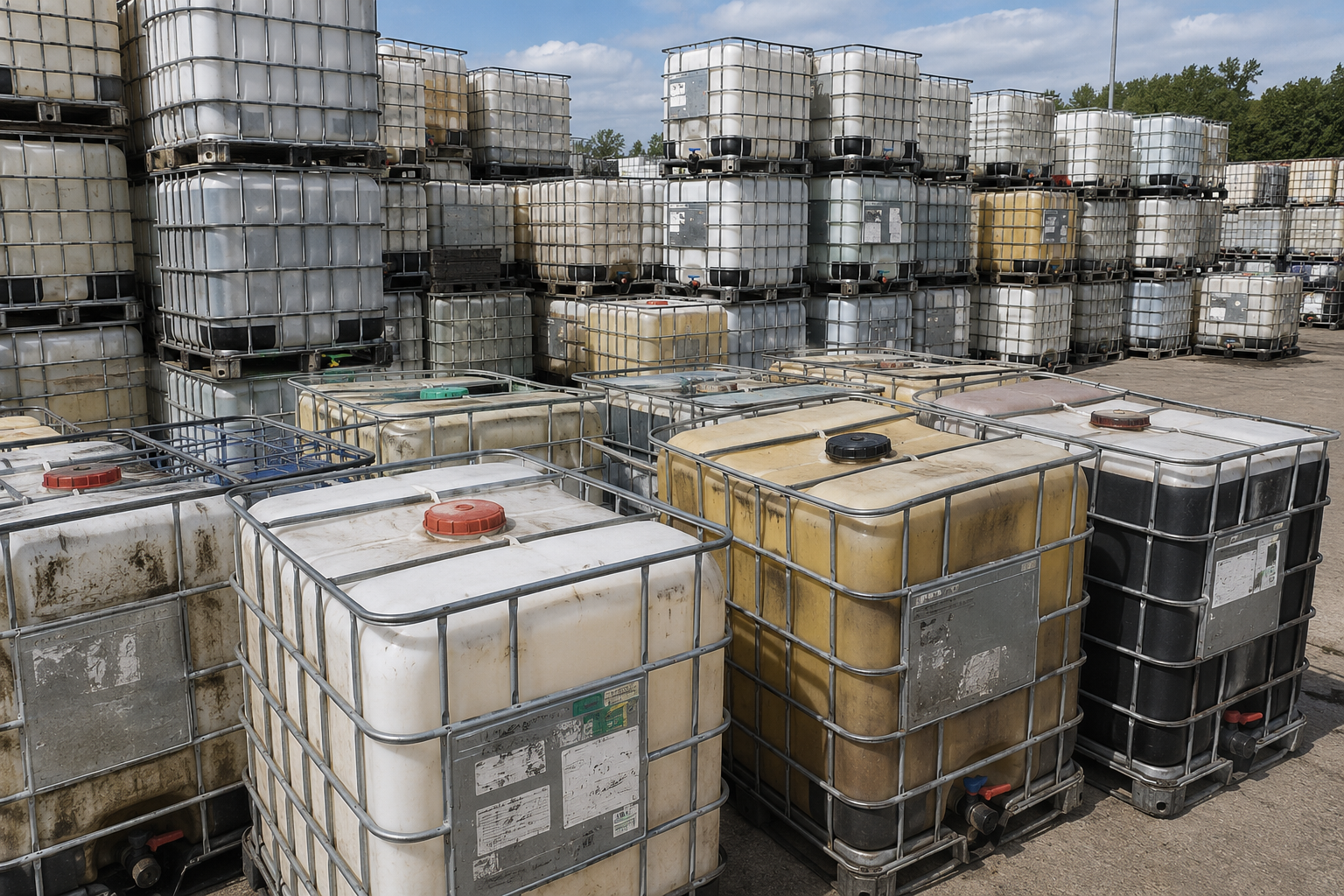
These are real totes in the queue — clean empties bought from food producers, distributors and farms across the region, lined up for intake. Each one is a deferred landfill entry and a deferred factory order: roughly 60 kg of CO₂e, 180 liters of process water and 18 kg of virgin HDPE that never has to be spent again.
Keeping the yard local is deliberate. Reconditioning within New England means short transport legs at both ends — your empties travel a little way to us, our reconditioned stock travels a little way to you — instead of long-hauling new units across the country.
Why local mattersA tight New England loop beats a long national haul.
Reuse only stays green if you don't undo the savings in freight. Shipping an empty tote is notoriously inefficient — a bulky container "cubes out" a truck long before it weighs it out, so you're paying to move mostly air over every mile. The further a tote travels, the more of its reuse advantage you burn at the diesel pump.
That is the entire logic behind keeping our loop regional. When the company that buys your empty and the company that sells you a reconditioned unit are the same operation, in the same metro, the transport legs at both ends stay short. We batch pickups and deliveries by route so a truck that drops totes in Worcester collects empties on the way back, instead of running half-loaded.
The payoff is threefold: lower freight cost passed back to you, faster lead times because stock is staged nearby, and a genuinely smaller carbon number because the miles are short and the trucks run full. A reused tote that travels 30 miles is a very different climate story than a new one trucked 1,500.
What you can count onSix promises behind every tote we move.
Small company, tight loop, written word. These aren't fine print — they're how we've kept farms, breweries and factories coming back since 2014.
GuaranteeDocumented history, always
Every tote ships with its prior contents written on the label and its grade clearly marked. If a specific history is critical, we match inventory to your requirement rather than sending a random fill record.
GuaranteeWhat we quote is what arrives
Grade, size and condition are confirmed in writing before anything moves. If a tote genuinely doesn't match the quote, email us and we make it right — no phone queue, no runaround.
GuaranteeCleaned to a real standard
Triple-rinse is the baseline, with a sanitizing pass on every food-grade unit. We'll tell you honestly when an application needs Grade A, and when a cheaper Grade B is the smarter, greener call.
GuaranteeHonest about what we can't take
We won't buy or process totes that held hazardous chemistry we can't safely clean, and we won't sell you a new tote you don't actually need. Straight answers protect you and the loop.
GuaranteeRight part, right seal
Reusing a tote you already own? We supply just the worn valve, gasket, cap or adapter — and match EPDM or Viton to your product, because the seal's chemical limits are often tighter than the bottle's.
GuaranteeA loop, not a one-off
Turn totes over regularly and we'll hold your grade, prioritize your orders, and run a closed route that delivers reconditioned units and collects your empties on the same trip.
How we think about waste"Waste" is just an asset in the wrong place.
A retired tote isn't garbage — it's HDPE and galvanized steel that already paid its carbon price at the factory. Throwing it away means paying that price again for a replacement. We'd rather extract every cycle of value first.
That's why nothing usable gets crushed, and nothing crushed gets buried if a recycler will take the material. It's also why we'd rather sell you a Grade B industrial tote than a new one you don't actually need.
See the eco math Our service area
We buy, sell, recondition and haul throughout New England — Massachusetts, Rhode Island, New Hampshire, Connecticut, Vermont and Maine — out of our facility at:
32 Cobble Hill Rd
Somerville, MA 02143
Visit or email us →Good to knowQuestions about working with us.
The short version of who we are and how we operate. For tote specifics, see the full FAQ.
Where are you located and what areas do you serve?+
We operate from 32 Cobble Hill Rd in Somerville, Massachusetts, and serve all six New England states — Massachusetts, Rhode Island, New Hampshire, Connecticut, Vermont and Maine — plus parts of eastern New York. Greater Boston runs are fast and frequent; longer hauls are batched by route to keep freight efficient.
Why are you email-only with no phone number?+
Because it's better for you. Email gives both sides a written record of grade, prior contents, freight and price, so there are no surprises and no pressure. You reach a real person who answers in writing — usually within a business day — instead of a sales room chasing a quota.
What makes a reconditioned tote as good as new for most jobs?+
The carbon-intensive parts of an IBC — the HDPE resin and the galvanized steel cage — are engineered to outlast many fill cycles. Once a bottle is triple-rinsed, pressure-tested and re-gasketed, it performs identically to a new one for the vast majority of applications, at a fraction of the cost and embodied carbon.
Do you only sell, or do you also buy and haul?+
All of it — buying, selling, reconditioning, recycling and transport are the segments of one circular loop. We buy your clean empties, recondition them on our line, sell reconditioned and rebottled stock, regrind what truly fails, and run the pickups and deliveries ourselves across New England.
The ethos in numbers
Small company, tight loop, real impact.
2014
Reusing totes from the same Somerville block ever since.
6 states
New England service area for pickup & delivery.
4 stages
Reuse → rebottle → upcycle → regrind, in that order.
0
Phone lines. Straight answers by email instead.