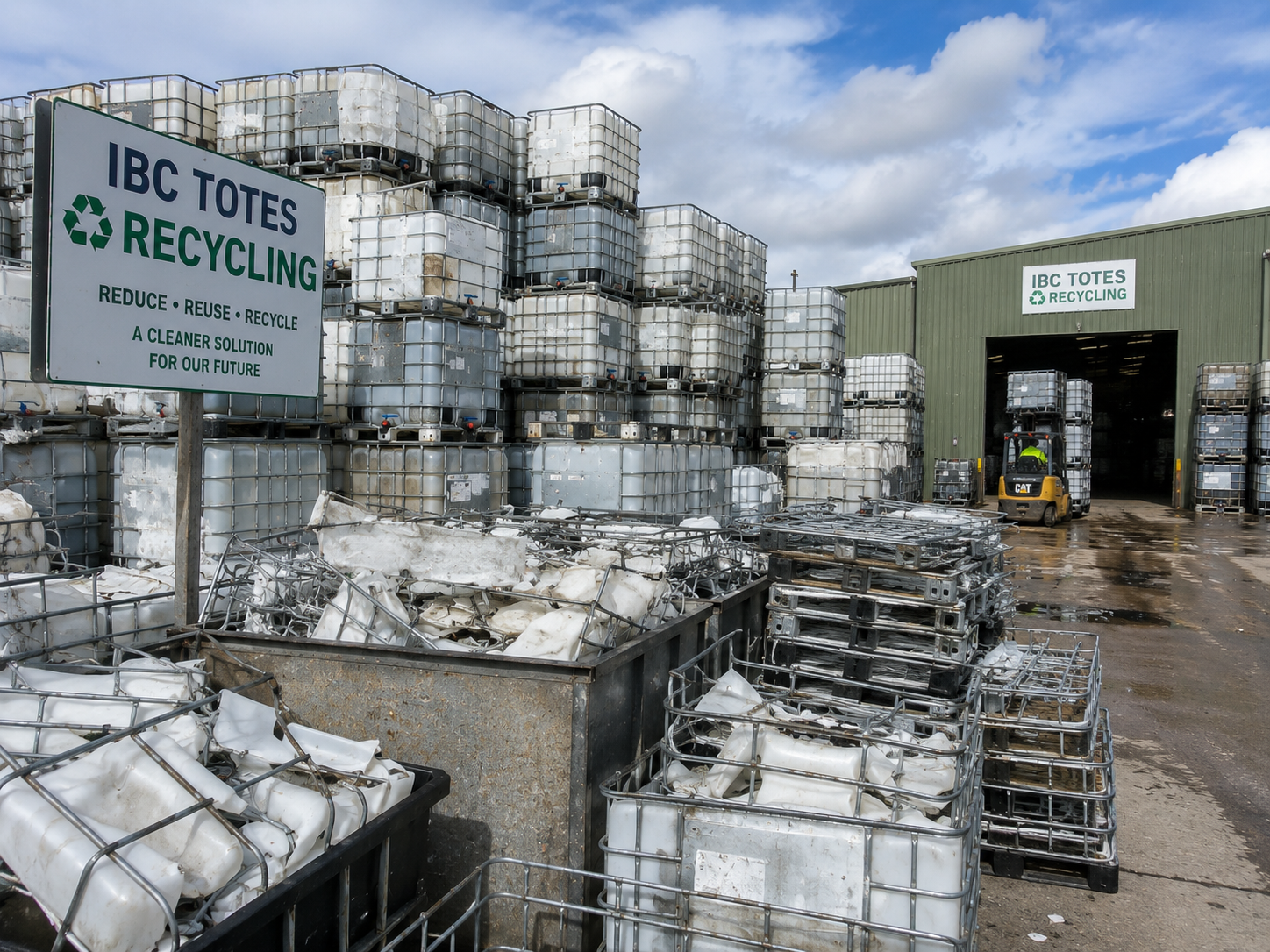
Reuse
A washed, pressure-tested tote goes straight back into service with its original bottle. Lowest footprint, highest value — always our first move.
Reuse isn't a marketing layer bolted onto our business — it is the business. Here's the math, the method, and a calculator to run your own numbers.
Tell us your volumes and we'll spec a reuse-first solution — and the impact that comes with it.
Reconditioning and reusing one existing IBC tote avoids roughly 60 kg of CO₂e, conserves about 180 liters of process water, and keeps around 18 kg of virgin HDPE out of new production and out of the landfill — compared with manufacturing a brand-new tote. Multiply that across a fleet and the savings are substantial.
CO₂e avoided per reused tote vs. new build.
Process water conserved per tote reused.
Virgin HDPE kept in service, out of landfill.
Manufacturing energy not spent on a new tote.
Drag the slider to your tote volume and watch the avoided carbon, water, plastic and energy add up. It's the fastest way to turn a sustainability goal into a number you can report.
How many IBC totes are you reusing instead of buying new?
Estimates use conservative HDPE + steel life-cycle figures. Your mileage varies by tote size and prior contents — but the direction is always the same: reuse wins.
A new IBC tote carries an embodied footprint long before it holds a drop of product. The energy-intensive steps happen once at the factory — but reuse lets a single set of those steps serve many fill cycles instead of one.
"Reuse moves the factory's carbon cost from once-per-trip to once-per-many-trips. That's the whole game."
Every tote that comes through our door is pushed to its highest possible use before any material is recycled. We move down this ladder only when we have to.
A washed, pressure-tested tote goes straight back into service with its original bottle. Lowest footprint, highest value — always our first move.
When a bottle is spent but the cage and pallet are sound, we drop in a new HDPE bottle and reuse the carbon-heavy steel. New-tote cleanliness, fraction of the impact.
Retired-but-intact bottles and cages become rain barrels, planters and storage instead of being shredded prematurely.
Only when a unit truly fails do we shred the HDPE into regrind for the plastics supply chain and route steel cages and pallets to metal recyclers.
Curious how reconditioning actually works on the line? Walk the triple-rinse-to-regrind process →
Round numbers should still be honest numbers. Our per-tote figures are conservative estimates derived from published life-cycle ranges for HDPE bulk containers and galvanized steel, not marketing math. Here is exactly where each one comes from — and what it does and doesn't include.
The core comparison is simple: the footprint of building and shipping a new tote versus the footprint of reconditioning an existing one. The dominant costs of a new unit — polymerizing virgin resin and forming and galvanizing steel — happen only once at the factory. Reuse skips them entirely. What reuse adds back is the wash line: hot water, detergent, the energy to heat and pump it, and a short local transport leg. We subtract that added cost rather than pretend it's zero, then publish the rounded, lower-to-middle figure.
| Metric | Per reused tote | Where it comes from |
|---|---|---|
| CO₂e avoided | ~60 kg | New-build embodied carbon (~55–70 kg) minus the wash-line and short-haul footprint. |
| Process water conserved | ~180 L | Water embodied in virgin resin and steel production, net of reconditioning water use. |
| Virgin HDPE kept in service | ~18 kg | Approximate mass of a 275/330-gallon HDPE bottle not re-manufactured from new resin. |
| Manufacturing energy avoided | ~95 kWh | Polymerization, blow-molding, steel forming and galvanizing energy not repeated. |
These are regional, conservative estimates for guidance, not a certified third-party LCA. Real figures vary with bottle size, steel content, prior contents and transport distance — which is exactly why we keep the loop local and the claims modest.
It would be easy to claim reconditioning is "free." It isn't. A triple-rinse plus sanitizing pass uses hot water and food-safe detergent; pumps, testers and tools draw power; and even a short pickup leg burns diesel.
We subtract all of that before we publish a savings number. The reason reuse still wins by a wide margin is that the wash line is a small cost next to the two giants it avoids: producing virgin HDPE resin and forming and galvanizing steel. Skip those — as reuse does — and the remaining footprint is a rounding error by comparison. Captured residual liquids, meanwhile, go to licensed disposal, never to the ground.
See what happens on the line →Follow a single container from a producer's empty pallet all the way to material recovery. Each stage extracts as much value as possible before handing off to the next.
A clean, sound empty is bought from a producer, distributor or farm and trucked a short distance to our Somerville hub — the carbon in its HDPE and steel already long since spent.
Triple-rinse, pressure-test, re-gasket and re-valve return the tote to service-ready condition using mostly hot water, detergent and a short local transport leg.
Graded, labeled and delivered, the tote does another full tour of fill cycles — the single highest-value, lowest-footprint outcome on the ladder.
When a bottle finally wears out but the steel is sound, a new HDPE bottle drops into the reused cage — keeping the most carbon-intensive component in play.
Sound-but-retired bottles and cages become rain barrels, planters and storage rather than being shredded a moment too early.
Only at true end-of-life is HDPE shredded into regrind for the plastics supply chain and steel routed to metal recyclers — nothing usable crushed, nothing crushed buried.
Reuse → rebottle → upcycle → regrind, in strict order.
Of recoverable totes washed, tested & returned to service.
Galvanized cage and steel pallet — endlessly recyclable.
Usable totes crushed; nothing crushed buried if recyclable.
Sustainability is only credible if the operator behind it is disciplined. These are the rules we hold ourselves to — including the uncomfortable ones about counting our own footprint.
Recycling is the floor, not the goal. A tote that re-enters service avoids far more impact than one that's shredded, so we exhaust every cycle of reuse, rebottling and upcycling before any material is recovered.
We publish round, conservative per-tote figures drawn from the lower-to-middle of published HDPE and steel life-cycle ranges. We'd rather under-promise the savings than inflate them.
Reconditioning within New England keeps transport legs short at both ends. Long-hauling totes — empty or new — quietly erodes the very savings reuse is supposed to deliver.
Nothing usable is crushed and nothing crushed is buried if a recycler will take the material. Regrind and steel recovery are the last resort, not the default.
We'll steer you to a Grade B industrial unit over a new one, or to rebottled over first-trip, whenever it meets your need. The greenest sale is the one that avoids virgin material.
Reuse isn't free of impact — washing uses hot water, detergent and energy. We count that cost honestly, and it remains a small fraction of building new.
Cracked or contaminated bottles are shredded into clean HDPE regrind that re-enters the plastics supply chain — becoming pipe, lumber, or new packaging instead of landfill volume.
Galvanized cages and steel pallets are among the most recyclable materials on earth. We sort and send them to metal recyclers where they're melted down and reborn — endlessly.
We'd rather you interrogate the claims than take them on faith. Here are the ones we hear most — answered the same way we answer everything: in writing.
Ready to turn this into an order? Browse used stock, sell us your empties, or see reconditioning & recycling.