IBC tote size chart & specs.
The numbers that decide fit, freight and fill weight. Answer-first: both common totes share a 48 × 40 inch footprint; the 330 gallon is simply taller than the 275 gallon.
Know your size? Get it quoted.
Tell us the capacity, grade and quantity you need and we'll match it from stock.
Same footprint, different height — that's the whole story.
Shared pallet footprint — fits standard racking and truck floors.
Height of a 275-gallon tote.
Height of a 330-gallon tote.
Typical safe stack when filled and rated.
275 vs. 330 gallon, side by side.
Figures are typical for reconditioned and rebottled units; exact weights vary by cage and pallet type. Need an exact spec sheet for a specific tote? Just ask on the form above.
| Specification | 275 Gallon | 330 Gallon |
|---|---|---|
| Nominal capacity | 275 gal / 1,040 L | 330 gal / 1,250 L |
| Footprint (L × W) | 48 × 40 in (122 × 102 cm) | 48 × 40 in (122 × 102 cm) |
| Overall height | ~46 in (117 cm) | ~53 in (135 cm) |
| Empty weight (typical) | 115–125 lb (52–57 kg) | 150–160 lb (68–73 kg) |
| Bottle material | Blow-molded HDPE | Blow-molded HDPE |
| Cage | Galvanized tubular steel | Reinforced galvanized steel |
| Pallet base options | Steel · composite · plastic | Steel · composite · plastic |
| Discharge valve | 2" butterfly or ball | 2" butterfly or ball |
| Fill / vent cap | 6" screw cap | 6" screw cap |
| Forklift entry | 4-way | 4-way |
| Stacking (filled) | 2 high typical | 2 high typical |
| UN/DOT rating | 31HA1/Y on rated units | 31HA1/Y on rated units |
Beyond 275 & 330: the full size range.
The 275 and 330 gallon totes are what we stock in depth, but IBCs come in a range of capacities. Heights are approximate and vary by manufacturer and pallet type; most share the 48 × 40 inch class footprint.
| Capacity | Liters | Approx. L × W × H | Typical use |
|---|---|---|---|
| 110 gal | 416 L | 40 × 48 × 35 in | Compact jobs, tight clearances |
| 120 gal | 454 L | 40 × 48 × 38 in | Smaller bulk batches |
| 180 gal | 681 L | 40 × 48 × 42 in | Mid-size storage |
| 250 gal | 946 L | 40 × 48 × 44 in | High-density without full height |
| 275 gal | 1,040 L | 48 × 40 × 46 in | The everyday standard |
| 330 gal | 1,250 L | 48 × 40 × 53 in | Max volume, same footprint |
The base under the bottle matters.
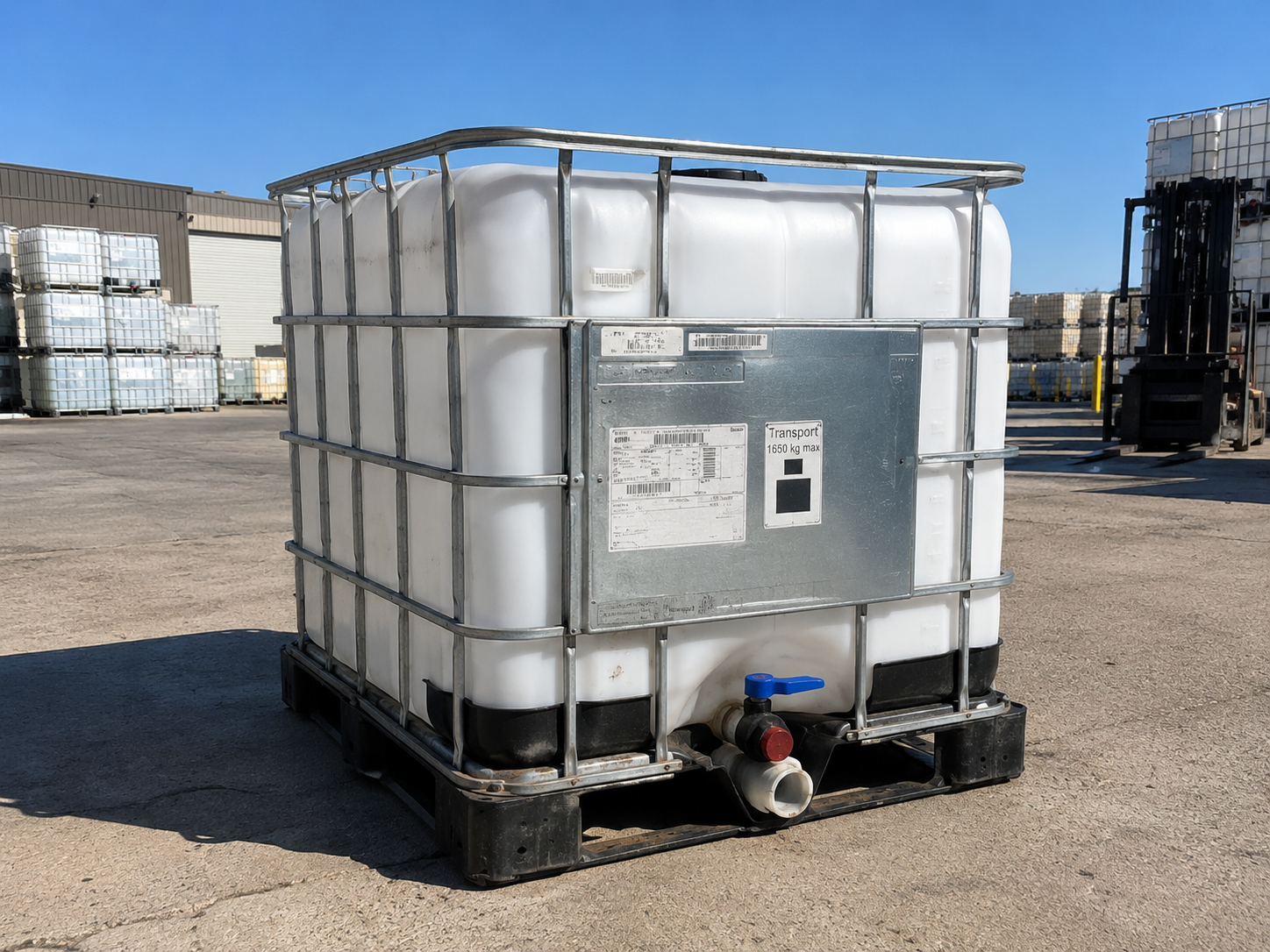
The steel cage carries the stacking load and protects the bottle; the pallet base sets weight, washability and cost. Here's how the common combinations compare — tell us your priority and we'll match it.
| Cage & pallet type | Characteristics | Best for |
|---|---|---|
| Steel cage & steel pallet | Most durable, fully recyclable, heaviest, best for repeated reuse and racking. | Industrial reuse, heavy stacking, returnable programs |
| Steel cage & composite pallet | Wood-block + plastic deck base; lighter than steel, good 4-way entry. | General-purpose buying where weight matters |
| Steel cage & plastic pallet | All-plastic base; washable, no wood, lighter for shipping. | Food-grade and wash-down environments |
| Steel cage & wood pallet | Traditional wood skid; lowest cost, may need ISPM-15 for export. | Domestic one-way or budget freight |
Outlets and openings, decoded.
Two openings do almost all the work: a 2-inch valve at the bottom for discharge and a 6-inch cap on top for filling and venting. Adapters thread onto the outlet to match whatever hose or fitting you already run.
| Fitting | What it is |
|---|---|
| Discharge valve — 2" butterfly | Quarter-turn handle, fast on/off, the most common outlet on used totes. |
| Discharge valve — 2" ball | Smooth full-bore flow, easy to throttle, common on newer units. |
| Valve outlet thread — S60×6 (DN50) | The buttress 'coarse' thread most 2-inch tote valves and adapters use. |
| Camlock / hose adapters | Screw onto the S60×6 outlet to convert to camlock, NPT or garden-hose. |
| Fill cap — 6" (DN150) | Screw lid on top for filling, venting and cleaning access; gasketed. |
| Vented vs. solid caps | Vented caps relieve pressure during temperature swings; solid caps seal fully. |
Need a specific adapter or a replacement valve? We stock parts — see accessories & parts.
Fill-weight math, made simple.
A full tote is heavy — and the liquid usually outweighs the container many times over. To estimate a filled tote's weight, multiply the volume in gallons by 8.34 lb (the weight of a gallon of water), then by your liquid's specific gravity, and add the empty tote weight.
Filled weight ≈ (gallons × 8.34 × specific gravity) + empty weight
Example: 275 gal of water ≈ 275 × 8.34 × 1.00 = 2,294 lb of liquid, plus ~120 lb of tote ≈ 2,414 lb total. Always confirm forklift and rack ratings before stacking.
| Liquid (specific gravity) | SG | 275 gal liquid | 330 gal liquid |
|---|---|---|---|
| Water (1.00) | 1.00 | ~2,290 lb | ~2,750 lb |
| Diesel / light oil (0.85) | 0.85 | ~1,950 lb | ~2,335 lb |
| Glycol / antifreeze (1.11) | 1.11 | ~2,540 lb | ~3,050 lb |
| Brine solution (1.20) | 1.20 | ~2,750 lb | ~3,300 lb |
| Honey / syrup (1.42) | 1.42 | ~3,250 lb | ~3,900 lb |
Liquid weight only — add the empty tote weight for the loaded total.
How many fit on a truck, a rack, a slab.
On the floor
At 48 × 40 in each, totes line up two-across the width of a standard 53-foot trailer. That's roughly 40–44 totes on the deck of a full van — empties usually "cube out" the trailer long before they reach the weight limit.
Stacked two-high
Empty or filled-and-rated totes stack two high for storage and transport, doubling effective truck capacity. Confirm the bottom tote's rating and your beam height before doubling up — the 330's extra 7 inches matters.
In a rack
Both totes drop into standard selective pallet racking on the GMA 48 × 40 footprint. Size beam openings for a 330 (≈53 in plus clearance) if you ever plan to mix sizes in the same bay.
How to measure your space in five steps.
Measure the footprint
Mark a 48 × 40 in rectangle where each tote will sit, plus a few inches of breathing room around it.
Check the height
Allow ~46 in for a 275 or ~53 in for a 330, then add cap and hose clearance overhead.
Plan the access path
Confirm doorways, aisles and forklift turning room handle a loaded tote on a pallet jack.
Verify the floor
A filled tote can top 2,400 lb — make sure the slab, mezzanine or trailer is rated for it.
Decide on stacking
If stacking two-high, double the height and confirm rack-beam and rating limits first.
275 or 330 gallon — which fits you?
- 275The default. Lighter when full, easier to handle, fits low ceilings and most box trucks two-high.
- 33020% more volume in the same floor space — fewer units, fewer handling cycles for high-throughput operations.
Racking & truck fit
Both totes use the universal 48 × 40 inch GMA pallet footprint, so they drop into standard selective racking and line up neatly on a 53-foot trailer (two across the width). Confirm beam height before storing 330s two-high — that extra 7 inches matters.
Got your size? Let's get it on a truck.
We stock every grade, and we deliver across New England.
Request a quote