Grade Afrom $109
275 Gal Food-Grade Reconditioned
Triple-rinsed, food-grade prior contents only. Ideal for water, beverages, and edible oils.
See specs →IBC Boston buys, sells, reconditions, recycles and hauls IBC totes across New England. Same rugged tanks, a fraction of the cost — and a tiny fraction of the carbon.
Buying, selling, reconditioning, or hauling? One short form and we'll reply by email, usually within a business day.
CO₂e avoided per reused tote vs. new build.
Of recoverable totes washed, tested & returned to service.
275 & 330 gallon — the workhorses of bulk liquid.
Phone numbers. We work entirely by email and on-site.
Every tote you reuse instead of buying new keeps carbon, water, plastic and energy out of the system. Move the slider and watch your footprint shrink — then turn the number into an order.
How many IBC totes are you reusing instead of buying new?
Estimates use conservative HDPE + steel life-cycle figures. Your mileage varies by tote size and prior contents — but the direction is always the same: reuse wins.
Triple-rinsed, food-grade prior contents only. Ideal for water, beverages, and edible oils.
See specs →Washed industrial totes for non-potable use: rainwater, compost tea, dust control, brine.
See specs →Larger footprint for high-volume storage and bulk liquid handling operations.
See specs →A new IBC embodies the carbon of virgin HDPE resin, smelted steel, and a factory's worth of energy. Reuse that container and you avoid nearly all of it. We make reuse the obvious, affordable default — for your budget and the planet.
"We treat a used tote as an asset to be kept in service — not waste to be replaced."
That single principle decides what we buy, how we recondition, and when we finally regrind.
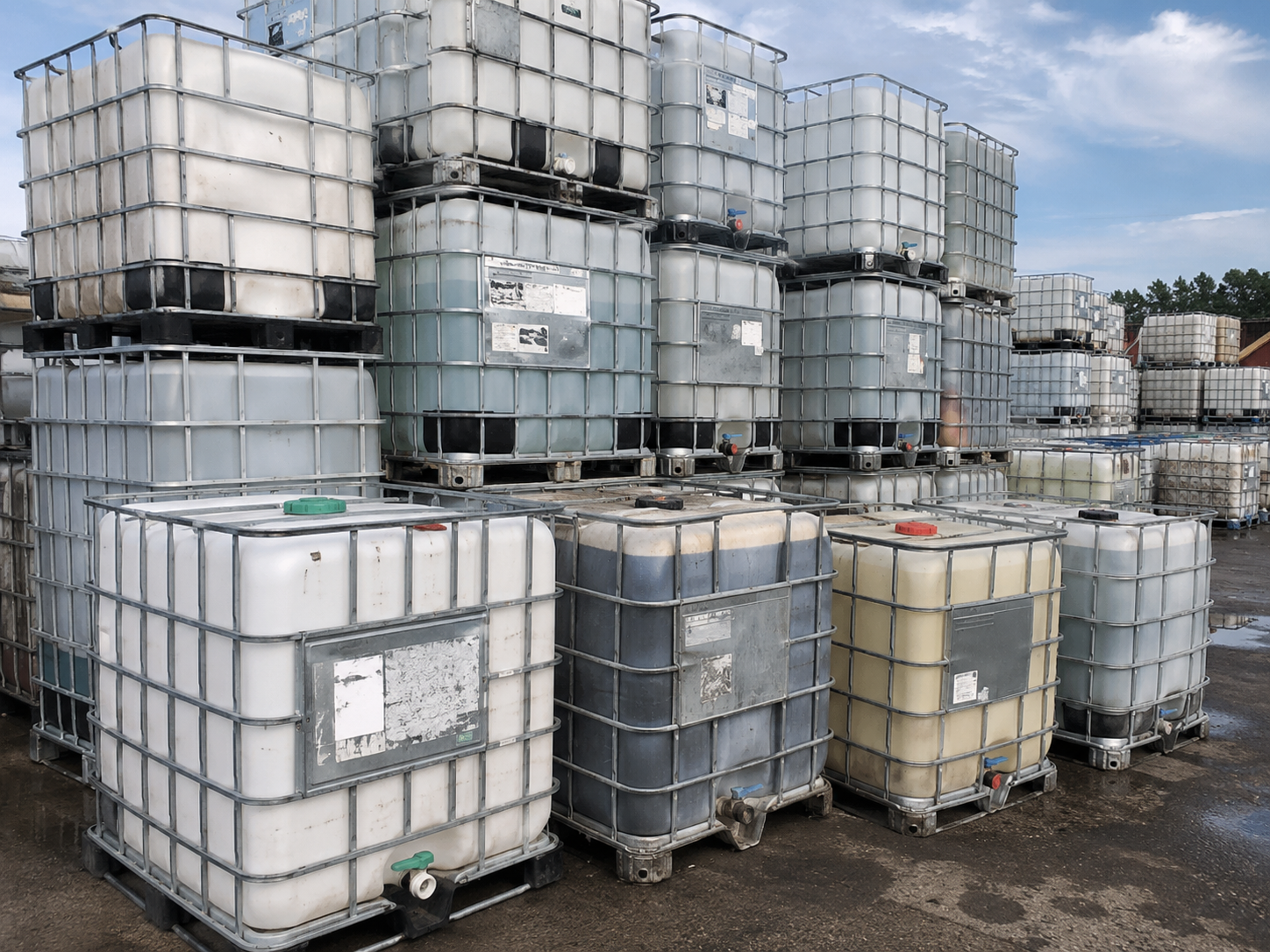
What you see here is the actual stock that flows through our Somerville hub: rows of 275s and 330s coming off the wash line, staged by grade, waiting for the next dock that needs them. Every one of these started as someone else's "empty problem" — and is on its way to a second, third, or tenth working life.
When you buy from a stocked, reconditioned yard instead of ordering virgin units from a plant, the lead times shrink, the freight legs shorten, and the carbon you avoid is real and measurable — roughly 60 kg of CO₂e per tote kept in service.
An intermediate bulk container — IBC for short — is a cube-shaped tank that moves between roughly 110 and 550 gallons of liquid in a single forkliftable unit. The two sizes that do almost all the real work are the 275 and the 330 gallon. Understanding the four parts is the fastest way to know exactly what reuse is saving.
The bottle is blow-molded high-density polyethylene (HDPE), usually translucent so you can read the fill level at a glance. The cage is galvanized tubular steel that carries stacking loads and shields the bottle from impact. The pallet is a steel, composite, or plastic base rated for 4-way forklift entry. At the base sits a 2-inch discharge valve (butterfly or ball); up top a 6-inch screw cap handles filling, venting, and cleaning access.
Here is the reuse insight that drives our whole business: the galvanized steel cage and pallet routinely outlast many fill cycles, and the HDPE bottle, once washed and pressure-tested, performs identically to a new one for the vast majority of applications. The energy-intensive manufacturing — resin polymerization and steel forming — already happened once. Reuse simply lets that single set of factory steps serve trip after trip instead of being repeated for each new container.
Same footprint, same fittings, different height and capacity. Both fit standard pallet racking and a box-truck floor, so the choice usually comes down to how much volume you need per pallet position versus the clearance you have overhead.
| Spec | 275 gallon | 330 gallon |
|---|---|---|
| Capacity | 275 gal / 1040 L | 330 gal / 1250 L |
| Footprint | 48 × 40 in | 48 × 40 in |
| Overall height | ~46 in | ~53 in |
| Empty weight | ~115–120 lb | ~155 lb |
| Loaded weight (water) | ~2,400 lb | ~2,900 lb |
| Discharge valve | 2 in butterfly / ball | 2 in butterfly / ball |
| Fill cap | 6 in screw cap | 6 in screw cap |
| Forklift entry | 4-way | 4-way |
| Best for | Tight height / weight limits | Maximum volume per position |
Shared footprint — both sizes rack and load identically.
Standard bottom discharge valve, butterfly or ball.
Screw-top fill cap for filling, venting and cleaning.
Water weight — multiply by specific gravity for your load.
Four steps, zero phone calls. The whole process is built to be fast, written, and honest — so you always have a paper trail and never a runaround.
Tell us size, grade, quantity and your town. No account, no phone tag — it routes straight to a real person.
We confirm stock, prior contents and freight, then reply by email — usually within a business day.
Say yes and we lock a delivery or pickup window across New England, batched by route to keep freight lean.
Each unit arrives washed, tested, graded and labeled with its documented history. Empties? We collect those too.
Part of why reused totes are so sustainable is sheer versatility — a single unit serves farms, breweries, factories and town yards across New England without ever touching a landfill.
Rainwater capture, compost tea, fertilizer and irrigation reservoirs — Grade B industrial does the job for less.
Food-grade 275s for process water, juice, syrup and edible oils, with documented FDA-compliant prior contents.
Bulk ingredient and process-liquid handling with a closed loop that takes your empties back off the floor.
Road brine, dust control, washdown water and ballast — rugged, forkliftable, and ready the day they land.
Looking for ideas? Our guide on 37 practical uses for a reused tote covers everything from aquaponics to maple-sap collection.
Still stuck? The form above reaches a real person — by email, always. Or browse the full FAQ.
Send one form. Get a real answer by email — no call centers, no runaround.
Start your quote